Key points
- For adults of any age, a normal clinic BP is below 130/85 by the International Society of Hypertension (ISH) 2020 guideline. Below 120/80 is often called optimal.
- The “100 plus your age” rule is a myth. Blood pressure tends to rise with age, but the healthy range does not.
- Treatment targets are a little more relaxed for many people over 65: ISH suggests below 140/90, ideally lower if tolerated.
- Low BP is usually defined as below 90/60. It matters only if it causes symptoms such as dizziness or fainting.
Normal blood pressure is one of the most searched health questions in India, and one of the most confused. This page sets out the numbers that guidelines use, and how they apply at different ages. For causes, symptoms and treatment, see our complete guide to high blood pressure.
What is normal BP?
For adults, the ISH 2020 guideline calls a clinic reading below 130/85 normal. Many doctors still refer to 120/80 or below as optimal, and the American and European guidelines both treat 120/80 as the point where risk starts to rise. In practice, if your readings are consistently below 120/80, your blood pressure is healthy. If they are between 120/80 and 129/84, they are still normal by the ISH definition, and worth keeping an eye on.
The same range applies to men and women, and to adults at every age.
BP range chart for adults
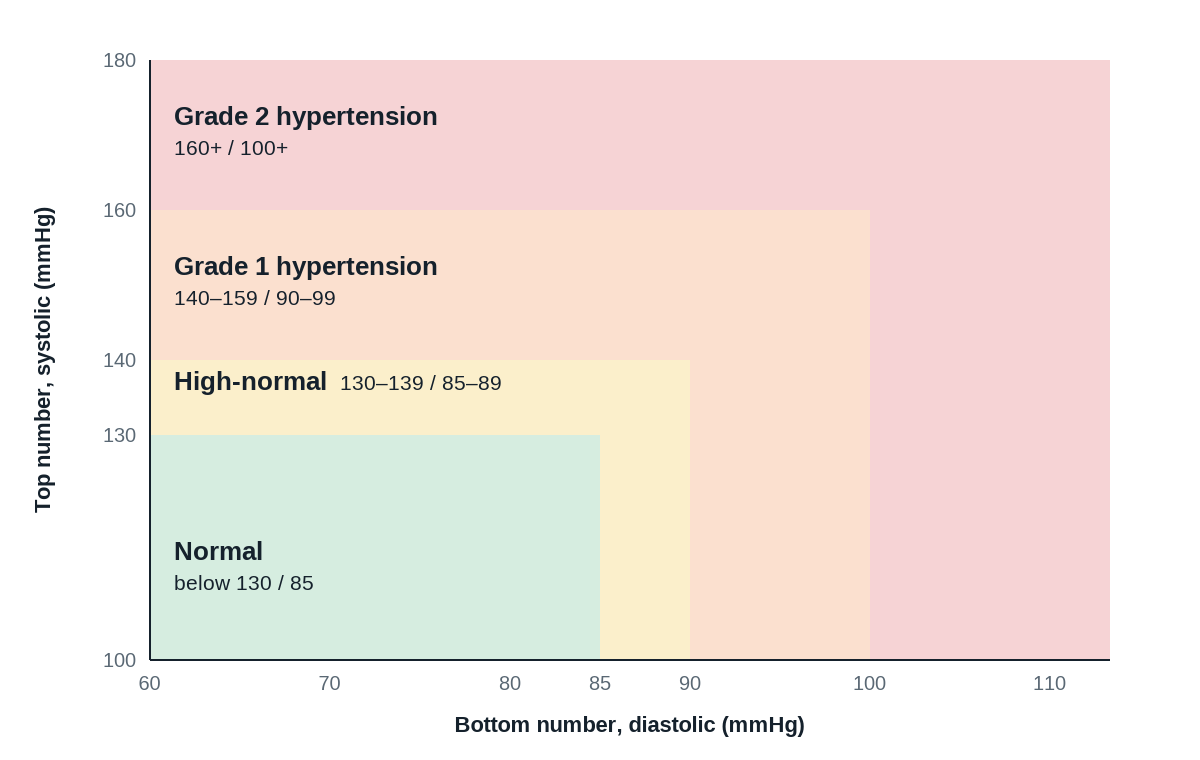
| Category (ISH 2020) | Top (systolic), mmHg | Bottom (diastolic), mmHg | What to do |
|---|---|---|---|
| Low | Below 90 | Below 60 | Only a concern if you have symptoms |
| Normal | Below 130 | Below 85 | Recheck at least every 3 years, or yearly if you have risk factors |
| High-normal | 130 to 139 | 85 to 89 | Lifestyle changes; recheck every year |
| Grade 1 hypertension | 140 to 159 | 90 to 99 | Confirm with repeat or home readings, then see a doctor |
| Grade 2 hypertension | 160 or more | 100 or more | See a doctor within days |
Try any reading in the checker below. It uses the same ISH 2020 categories.
Check a blood pressure reading
High-normal
Not hypertension, but a signal to act on salt, weight and activity. Recheck within a year.
Adult categories from the International Society of Hypertension 2020 guideline. One reading is not a diagnosis. This check runs in your browser and nothing is stored. What the numbers mean
Why the guidelines use different numbers
You may see different cut-offs on different websites. They come from three major guidelines that looked at the same evidence and drew the lines in slightly different places:
| Guideline | Normal or non-elevated | In between | Hypertension starts at |
|---|---|---|---|
| ISH 2020 (widely used in India) | Below 130/85 | 130–139 / 85–89 (high-normal) | 140/90 |
| ACC/AHA 2017 (United States) | Below 120/80 | 120–129 and below 80 (elevated) | 130/80 (stage 1) |
| ESC 2024 (Europe) | Below 120/70 | 120–139 / 70–89 (elevated) | 140/90 |
All three agree that risk rises steadily from around 115/75 upwards, so lower is generally better, as long as you feel well.
Blood pressure by age: what changes
As we age, the large arteries stiffen. This typically pushes the top number up, while the bottom number often levels off or falls after about 60. That is why high systolic pressure with a normal or low diastolic pressure, called isolated systolic hypertension, is the most common pattern in older adults.
So average BP in a population rises with age, but that average is not the same as healthy. A reading of 150/80 at 70 is common, but it still raises the risk of stroke and heart disease, and it still counts as hypertension.
| Age | Normal range | Usual treatment target if you have hypertension |
|---|---|---|
| 13 to 17 | Below 120/80 | Set by a paediatrician |
| 18 to 64 | Below 130/85 (optimal below 120/80) | Below 130/80 if tolerated (ISH 2020) |
| 65 to 79 | Below 130/85 (optimal below 120/80) | Below 140/90, ideally lower if tolerated (ISH 2020) |
| 80 and over | Below 130/85 (optimal below 120/80) | Set individually, avoiding dizziness and falls |
Targets for older adults
Lowering high blood pressure helps older people too, including those over 80. But the target is more individual. Doctors weigh the benefit against side effects such as dizziness on standing, falls and kidney changes. The European 2024 guideline suggests a top number of 120 to 129 for most treated adults if tolerated, and a more flexible approach for people who are 85 or older, or frail. If you feel light-headed after starting or changing a medicine, tell your doctor rather than stopping it.
Normal blood pressure for women
The normal range is the same for women and men. Some situations are specific to women:
- Pregnancy: 140/90 or above is high in pregnancy and needs attention, because it can be a sign of pre-eclampsia. Headache, vision problems, upper tummy pain or sudden swelling need same-day care.
- Contraceptive pills containing oestrogen can raise BP in some women, so BP should be checked before and during use.
- Menopause: BP often rises after menopause, so regular checks matter more from the 40s onwards.
Children and teenagers
Children's blood pressure is judged against charts for their age, sex and height, not adult numbers. The American Academy of Pediatrics recommends a BP check at every yearly visit from age 3. From age 13, the adult-style cut-offs apply: below 120/80 is normal, 120 to 129 with a bottom number below 80 is elevated, and 130/80 or above is high.
Low BP range
Low blood pressure (hypotension) is usually defined as below 90/60. Many healthy, active people, especially young women, have readings around 90/60 with no problems at all. Low BP needs attention only if it causes symptoms:
- Dizziness or light-headedness, especially on standing.
- Fainting or near-fainting.
- Blurred vision, confusion or unusual tiredness.
A drop of 20 or more in the top number, or 10 or more in the bottom number, within three minutes of standing up is called orthostatic hypotension. It is more common in older adults, with dehydration, and with some medicines. Common triggers in India include heat, fasting, diarrhoea and not drinking enough water. A sudden drop with chest pain, breathlessness, black stools or fainting needs urgent care: call 112.
Home readings: a slightly different normal
Readings taken at home are usually lower than clinic readings, because you are relaxed. So the cut-off for high blood pressure at home is lower: an average of 135/85 or above on home readings suggests hypertension. To get a true picture:
- Use a validated upper-arm machine with the right cuff size. Wrist machines are less accurate.
- Sit quietly for 5 minutes, back supported, feet flat, arm resting at heart level.
- Avoid tea, coffee, smoking and exercise for 30 minutes before.
- Take two readings a minute apart, morning and evening, for about a week, and write them down.
When to see a doctor
- Your readings are repeatedly 140/90 or above in a clinic, or 135/85 or above at home.
- Your BP is 180/110 or above: if you have chest pain, breathlessness, weakness, trouble speaking, vision changes or a severe headache, call 112.
- You feel dizzy or faint, especially on standing, or after a change in medicines.
- You are pregnant and your BP is 140/90 or above.
Frequently asked questions
What is normal BP for adults?
For adults of any age, a clinic reading below 130/85 is normal according to the International Society of Hypertension 2020 guideline, and below 120/80 is often called optimal.
Does normal blood pressure increase with age?
No. Blood pressure itself often rises with age, but the healthy range stays the same. The old rule of “100 plus your age” is a myth. Treatment targets can be a little more relaxed for many people over 65.
What is the normal BP for a 60-year-old?
The same as for any adult: below 130/85, ideally around 120/80. If a 60-year-old has hypertension, the usual treatment target is below 130/80 if tolerated.
What BP is too low?
Below 90/60 is usually called low. It is only a concern if it causes symptoms such as dizziness, fainting or blurred vision, or if it is new or sudden.
Is normal blood pressure different for women?
No, the range is the same. In pregnancy, 140/90 or above needs prompt attention because it can be a sign of pre-eclampsia.
Sources
- Unger T, et al. 2020 International Society of Hypertension Global Hypertension Practice Guidelines. Hypertension 2020;75(6):1334–1357.
- Whelton PK, et al. 2017 ACC/AHA/AAPA/ABC/ACPM/AGS/APhA/ASH/ASPC/NMA/PCNA Guideline for the Prevention, Detection, Evaluation, and Management of High Blood Pressure in Adults. Hypertension 2018;71(6):e13–e115.
- McEvoy JW, et al. 2024 ESC Guidelines for the management of elevated blood pressure and hypertension. Eur Heart J 2024;45(38):3912–4018.
- Flynn JT, et al. Clinical Practice Guideline for Screening and Management of High Blood Pressure in Children and Adolescents. Pediatrics 2017;140(3):e20171904.
- Freeman R, et al. Consensus statement on the definition of orthostatic hypotension, neurally mediated syncope and the postural tachycardia syndrome. Clin Auton Res 2011;21(2):69–72.
This article is general information for adults in India and is not a diagnosis or a treatment plan. Always discuss results and any changes with your own doctor. Read our editorial policy.